Railway and mass-transit systems increasingly use FRP composite materials because they offer lightweight construction, durability, corrosion resistance, and design flexibility. However, fire behaviour is an important consideration when composites are used in railway environments.
Selecting the right fire retardant resin for railway composites can help manufacturers develop FRP components suited to demanding transportation applications.
Vasavibala Resins (VBR) offers fire-retardant resin systems for rail and mass-transit applications, including Ortho and Iso FRR grades, halogen-free systems, low-smoke grades, and infusion-oriented options. VBR also offers FRR grades meeting the specifications of both ASTM E84 and EN 45545 HL3, subject to the applicable product grade and supporting test documentation.
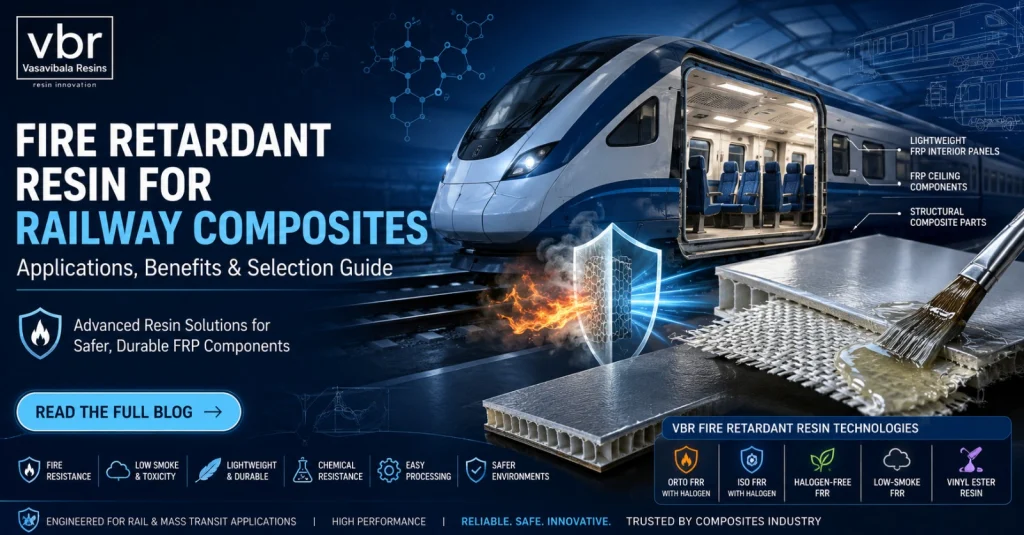
Railway vehicles can contain enclosed passenger areas where fire, smoke, and toxicity performance are important considerations.
A suitable fire retardant polyester resin can contribute to the fire-related performance of FRP components while maintaining the processing characteristics required for composite manufacturing.
Key factors include flame behaviour, smoke generation, toxicity considerations, mechanical strength, thermal stability, processing characteristics, and long-term durability.
The final performance depends on the complete composite system, including resin, reinforcement, laminate construction, additives, and manufacturing process.
Fire retardant resin is specially formulated to provide improved fire-related performance compared with standard resin systems.
VBR’s fire-retardant portfolio includes Ortho FRR, Iso FRR, Halogen-Free Ortho FRR, Halogen-Free Iso FRR, Low-Smoke Ortho FRR, Halogen-Free Ortho Infusion FRR, and Halogen-Free Iso Infusion FRR.
VBR also offers FRR grades meeting the specifications of both ASTM E84 and EN 45545 HL3. The appropriate grade should be selected according to the application, component construction, applicable specification, and relevant test documentation.
Fire-retardant resin systems can be considered for railway and mass-transit composite components including railway interior panels, partitions, ceiling components, composite panels, roof and translucent components, and structural or semi-structural FRP components.
The suitability of a particular resin grade depends on component design, laminate construction, manufacturing process, and applicable fire-performance requirements.
Fire retardant polyester resin can provide practical processing and performance for selected railway composite applications. Vinyl Ester Resin can be considered where higher chemical, thermal, and mechanical performance is required.
The appropriate resin should be selected based on the complete application rather than a single property.
— Identify the fire-performance requirements applicable to the specific railway component.
Consider smoke generation and toxicity requirements where applicable.
Ensure compatibility with RTM, infusion, hand lay-up, or closed moulding.
Consider strength, impact resistance, vibration, and expected service conditions.
Evaluate operating and heat-exposure conditions.
Consider viscosity, gel time, cure profile, fibre wet-out, exotherm, and demoulding.
Fire-performance requirements vary according to the application and project specification. VBR offers FRR grades meeting the specifications of both ASTM E84 and EN 45545 HL3.
ASTM E84 evaluates surface burning characteristics, while EN 45545-2 addresses fire behaviour requirements for materials and components used on railway vehicles. The applicable classification and test requirements should be confirmed for the specific product, component, and project.
Customers should refer to the relevant technical data, test reports, and product documentation when evaluating a resin for a particular application.
When appropriately designed and manufactured, fire-retardant FRP composites can provide lightweight construction, good strength-to-weight performance, corrosion resistance, design flexibility, efficient manufacturing, improved fire-related performance, and long-term durability.
Common mistakes include selecting resin based only on purchase price, ignoring chemical concentration, ignoring operating temperature, assuming one resin is suitable for every chemical, failing to consider fabrication and curing conditions, and not checking applicable design or industry requirements.
Vasavibala Resins (VBR) manufactures specialty resin systems for industrial FRP applications.
For railway and mass-transit applications, VBR offers fire retardant resin systems including Ortho, Iso, halogen-free, low-smoke, and infusion-oriented grades. VBR also offers FRR grades meeting the specifications of both ASTM E84 and EN 45545 HL3.
VBR also offers Vinyl Ester and Novalac Base Vinylester systems for applications requiring enhanced chemical, thermal, or mechanical performance.
The appropriate resin should be selected according to component design, manufacturing process, applicable project requirements, and relevant technical documentation.
It is a specially formulated resin system designed to improve the fire-related performance of FRP composite components used in selected railway applications.
It is an unsaturated polyester resin formulated to provide improved fire-related performance compared with conventional polyester resin.
Yes. VBR offers FRR grades meeting the specifications of both ASTM E84 and EN 45545 HL3. The applicable grade and supporting test documentation should be confirmed for the specific application.
Halogen-free systems can be considered where project specifications require particular fire, smoke, or material characteristics. The final composite should be evaluated against applicable requirements.
No. Suitability depends on the specific product grade, complete composite system, component design, classification, and required testing.
Consider fire, smoke and toxicity requirements, manufacturing process, mechanical properties, temperature exposure, component design, and applicable project specifications.
Selecting the right fire retardant resin for railway composites requires consideration of the complete application rather than fire performance alone.
Fire retardant polyester resin systems can provide practical solutions for selected railway FRP applications, while specialty Vinyl Ester and Novalac Base Vinylester systems may be considered where enhanced chemical, thermal, or mechanical performance is required.
VBR provides a range of fire retardant resin systems in India, including FRR grades meeting the specifications of both ASTM E84 and EN 45545 HL3. The technical team can help identify the appropriate resin based on the application, manufacturing process, project requirements, and relevant product documentation.

Pioneering Resins Since ’91 — stands for innovation, precision, and trust in resin manufacturing. Built on three
strong pillars — Unmatched Quality, Customization, and Timely Delivery
+91 -44 -2435 2397
+91 -44 -2435 8986
+91 -44 -2435 2394
Copyright © 2025 | All Rights Reserved | Design and Developed By SVS INFOTECH
Note: please mention preferred mode of communication
(whatsapp Or Mail)
Product Enquiry Forms
Note: please mention preferred mode of communication
(whatsapp Or Mail)