Gelcoat is a resin-based surface layer applied to the mould side of an FRP (Fiber Reinforced Plastic) product. It forms the visible surface after demoulding and contributes to the product’s appearance and surface performance.
For buyers evaluating a gelcoat resin manufacturer in India, the important consideration is whether the selected grade matches the manufacturing process and the actual service conditions of the finished FRP product. VBR offers a range of gelcoat grades with product-specific technical data for selection. VBR Gelcoats
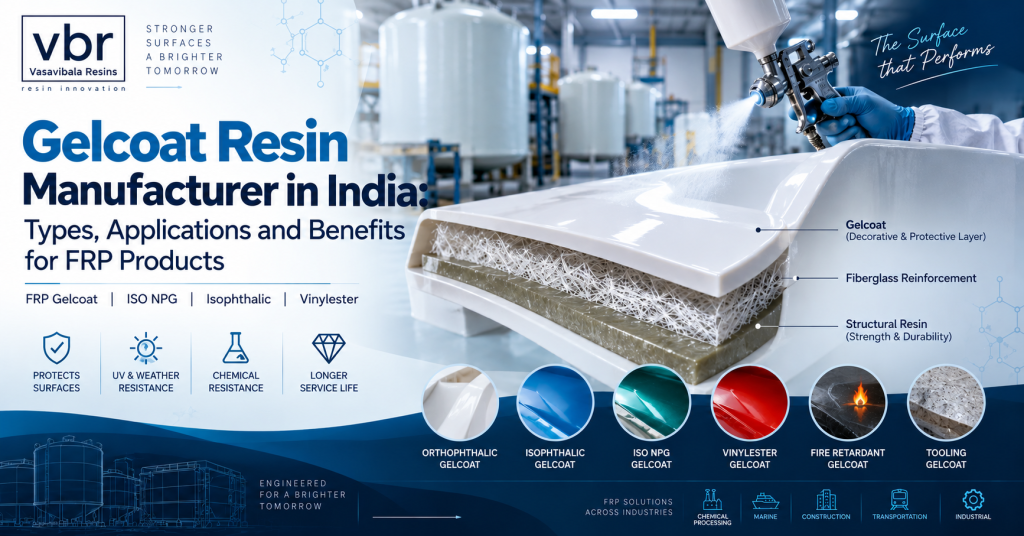
Gelcoat is applied as the first layer on the mould surface and becomes the visual side of the finished FRP product after demoulding. VBR describes gelcoats as an important application of polyester resins, with properties such as optical appearance, gloss, weather resistance, light fastness, chemical resistance and surface mechanical properties influencing the finished product.
Gelcoat should be treated as part of an FRP system rather than as a universal coating. The product TDS, laminate resin, reinforcement, manufacturing process and intended service environment should all be considered before selection.
VBR 6701 is an orthophthalic gelcoat formulated for hand lay-up application. Its TDS states good air release, good coverage in thin film, no drainage on the mould, and good water and weather resistance. These statements apply to VBR 6701 and should not be generalized to every orthophthalic gelcoat. View VBR 6701 TDS
VBR lists Iso Gelcoat and Iso Gelcoat Top Coat. Isophthalic grades should be selected according to the specific product TDS and intended service environment rather than assuming that every Iso grade has the same performance.
VBR 6706 is an isophthalic-based NPG gelcoat formulated for spray-up application. Its TDS states excellent water and chemical resistance, good coverage in thin film and no drainage on the mould. These are product-specific claims for VBR 6706. View VBR 6706 TDS
VBR lists Vinylester Gelcoat and Superior (Novalac) Vinylester Gelcoat as separate products. Selection should be based on the specific grade, service chemicals, temperature, process and applicable TDS rather than treating the category as universally suitable for all corrosive applications.
VBR lists Tooling Gelcoat as a dedicated product category. Tooling applications should be evaluated using the relevant product TDS and the requirements of the mould or tool.
VBR lists Pre-Accelerated Halogen-Free Ortho FR Gelcoat and Pre-Accelerated Halogen-Free Iso FR Gelcoat. Fire-retardant performance is system- and test-specific, so claims about meeting a particular standard should be made only for the applicable grade and supporting test documentation.
The benefits of gelcoat depend on formulation, process and service conditions. In general, gelcoat is used to provide a finished surface and to help protect the laminate.
The application method depends on the selected grade. For example, the VBR 6701 TDS specifies hand lay-up, while VBR 6706 specifies spray-up application.
Application thickness, curing conditions, catalyst/accelerator system and other processing parameters should always be taken from the current product TDS and VBR technical guidance.
This comparison is based specifically on the VBR 6701 and VBR 6706 TDS information reviewed for this article; it is not a universal comparison of every general-purpose or ISO NPG gelcoat.
Feature | VBR 6701 – Orthophthalic Gelcoat | VBR 6706 – ISO NPG Gelcoat
Resin type | Orthophthalic gelcoat | Isophthalic-based NPG gelcoat
Specified process | Hand lay-up | Spray-up
Water resistance | Good water resistance stated in TDS | Excellent water resistance stated in TDS
Chemical resistance | Not stated as a headline property in the reviewed TDS | Excellent chemical resistance stated in TDS
Thin-film coverage | Good coverage stated | Good coverage stated
Mould behaviour | Does not drain on mould | Does not drain on mould
Buyer note: neither grade should be selected solely from this table. Confirm the actual service conditions, manufacturing process and current TDS before purchase.
Gelcoat forms the mould-side surface, while the underlying resin and reinforcement form the structural FRP laminate. The two should be considered together when defining an FRP system.
VBR supplies both gelcoat and resin systems, allowing buyers to discuss the complete application rather than selecting a surface product in isolation. VBR Resins
VBR currently lists Ortho (GP) Gelcoat, Ortho (GP) Gelcoat Top Coat, Iso Gelcoat, Iso Gelcoat Top Coat, Pre-Accelerated Iso Gelcoat with UV, Pre-Accelerated Iso Gelcoat Topcoat with UV Sprayable, ISO NPG Gelcoat, Vinylester Gelcoat, Superior (Novalac) Vinylester Gelcoat, Low Shrinkage Superior Vinylester Gelcoat, Tooling Gelcoat, Pre-Accelerated Halogen-Free Ortho FR Gelcoat and Pre-Accelerated Halogen-Free Iso FR Gelcoat.
The VBR gelcoat product page identifies the relevant TDS reference for each grade. Buyers should use the applicable TDS for final product selection. VBR Gelcoat Product Range
Gelcoat forms the mould-side, visible surface of an FRP product after demoulding. It contributes to surface appearance and, depending on the grade, can provide relevant resistance or specialty performance.
ISO NPG gelcoat is an isophthalic-based NPG gelcoat. VBR 6706 is specified for spray-up application, and its TDS states excellent water and chemical resistance, good thin-film coverage and no drainage on the mould.
Gelcoat is the surface layer applied to the mould side, while structural resin works with reinforcement such as fiberglass to form the main composite laminate.
There is no single gelcoat that is automatically suitable for every chemical tank. Selection should consider the chemical, concentration, temperature, exposure time, laminate system and manufacturing process. The applicable VBR TDS and technical guidance should be reviewed before selection.
Yes, provided the selected grade is intended for the required outdoor conditions. VBR lists grades with weather- or UV-related properties, but the applicable product TDS should be checked for the specific application.
VBR manufactures and supplies multiple gelcoat grades, including Ortho, Iso, ISO NPG, Vinylester, Tooling and fire-retardant gelcoat products.
Gelcoat selection is application-specific. Share details such as the FRP product, manufacturing process, chemical or environmental exposure, operating temperature, required finish and any applicable performance standards.
Share your application requirements with VBR and enquire about the suitable gelcoat grade.
Gelcoat is an important part of an FRP product because it forms the visible surface and can provide application-specific protection and performance. The right choice depends on the manufacturing process and actual service environment, not simply on the broad gelcoat category.
VBR offers a range of gelcoat grades, including Orthophthalic, Isophthalic, ISO NPG, Vinylester, Tooling and fire-retardant options. For accurate selection, review the relevant product TDS and share the complete application requirements with VBR before finalizing the system.

Pioneering Resins Since ’91 — stands for innovation, precision, and trust in resin manufacturing. Built on three
strong pillars — Unmatched Quality, Customization, and Timely Delivery
+91 -44 -2435 2397
+91 -44 -2435 8986
+91 -44 -2435 2394
Copyright © 2025 | All Rights Reserved | Design and Developed By SVS INFOTECH
Note: please mention preferred mode of communication
(whatsapp Or Mail)
Product Enquiry Forms
Note: please mention preferred mode of communication
(whatsapp Or Mail)